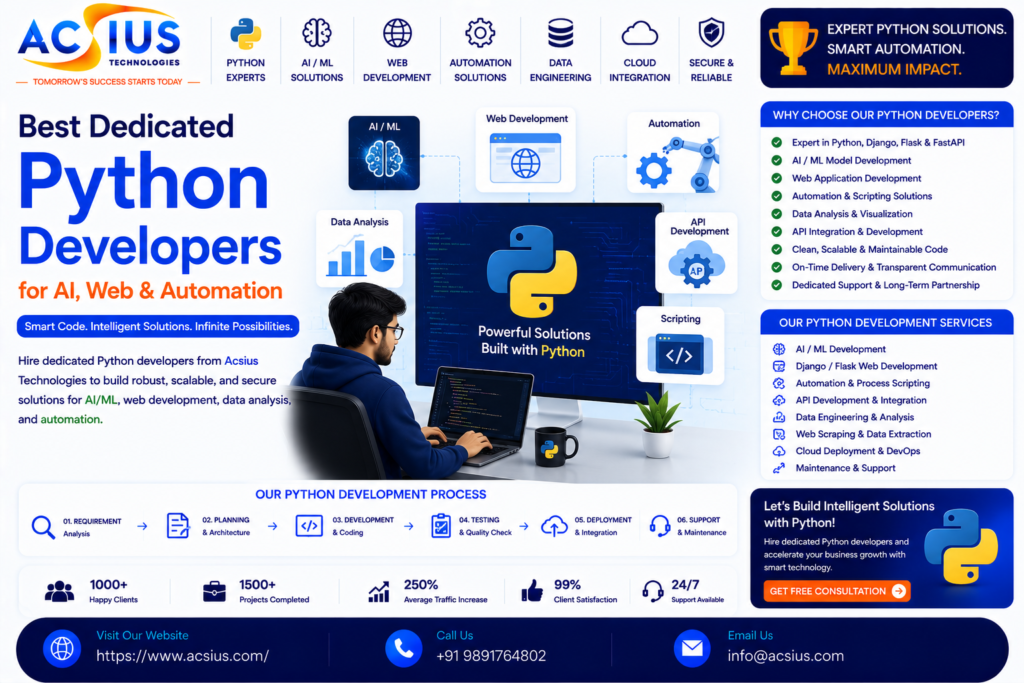

Python has quietly become the backbone of modern software development. From powering machine learning models to running e-commerce platforms and automating repetitive business tasks, Python’s flexibility and simplicity have made it the language of choice for startups and enterprises alike. If you’re building a product in 2026, chances are Python is either already part of your stack or should be.
But writing good Python code is only half the story. The real challenge for most businesses is finding developers who understand not just the syntax, but the architecture, scalability, and long-term maintainability that serious projects demand. That’s why more companies are choosing to hire dedicated python developer teams instead of relying on freelancers or in-house hiring alone. A dedicated developer works exclusively on your project, integrates with your existing team, and brings focused expertise to AI, web, and automation initiatives without the overhead of a full-time hire. Alongside Python, many businesses also look to hire magento developers for their e-commerce backends and hire flutter app developers for cross-platform mobile apps, creating a complete technology stack under one roof.
In this post, we’ll break down why Python remains dominant across AI, web development, and automation, what to look for in a dedicated Python developer, and how pairing Python expertise with the right e-commerce and mobile talent can help you build a complete, future-ready product.
Why Python Continues to Dominate in 2026
Python isn’t new, but its relevance keeps growing. Here’s why:
-
A Massive, Mature Ecosystem
Python’s library ecosystem is unmatched. Whether you need TensorFlow and PyTorch for deep learning, Django and Flask for web applications, or Selenium and PyAutoGUI for automation, there’s a battle-tested library ready to go. This reduces development time and lowers the risk of reinventing the wheel.
-
Readability That Speeds Up Collaboration
Python’s clean, English-like syntax makes it easier for teams to read, review, and maintain code. This matters enormously when you’re scaling a team or handing off a project between developers — something that happens often when businesses work with dedicated development partners.
-
Cross-Domain Versatility
Very few languages let you build a neural network, a REST API, and a web-scraping bot using the same core language. Python does. This versatility is exactly why businesses increasingly search for one team to cover AI, web, and automation instead of juggling separate vendors for each.
-
Strong Community and Long-Term Support
Python’s community support means faster bug fixes, more documentation, and a steady stream of new tools. For businesses making a long-term technology investment, this reduces risk considerably.
Python for AI: Where Most Businesses Are Investing Right Now
Artificial intelligence adoption has moved from experimental to essential. Every industry — retail, healthcare, logistics, finance — is now searching for ways to use AI to cut costs and improve decision-making. Python sits at the center of this shift.
Popular AI Use Cases Businesses Are Searching For
- Predictive analytics for demand forecasting and inventory planning
- Chatbots and virtual assistants for customer support automation
- Computer vision for quality control, security, and retail analytics
- Natural language processing (NLP) for sentiment analysis, document processing, and search
- Recommendation engines for e-commerce and content platforms
- Fraud detection models for fintech and banking applications
Building any of these systems requires more than basic scripting knowledge. It requires developers who understand data pipelines, model training, deployment, and monitoring — end to end. This is precisely where dedicated Python developers add value. Instead of a general-purpose freelancer, you get someone who has already solved similar problems and can move quickly from prototype to production.
What to Look for in an AI-Focused Python Developer
- Experience with machine learning frameworks (TensorFlow, PyTorch, scikit-learn)
- Strong grasp of data preprocessing and feature engineering
- Familiarity with cloud ML services (AWS SageMaker, Google Vertex AI, Azure ML)
- Understanding of MLOps for deploying and maintaining models in production
- Ability to work with large datasets efficiently using Pandas and NumPy
Python for Web Development: Still One of the Top Choices
Web development is another area where Python quietly leads. Frameworks like Django and Flask power everything from small business websites to large-scale platforms handling millions of users.
Why Businesses Choose Python for Web Projects
- Speed of development — Django’s “batteries-included” approach means authentication, admin panels, and ORM tools come built-in
- Security — Django has strong default protections against common vulnerabilities like SQL injection and cross-site scripting
- Scalability — Companies like Instagram and Spotify have proven Python can scale to massive user bases
- API-first architecture — Python integrates smoothly with modern frontend frameworks like React, Vue, and Flutter, making it ideal for decoupled applications
Common Web Development Needs Businesses Search For
- Custom web application development
- API development and third-party integrations
- SaaS platform development
- Backend modernization and legacy system migration
- Performance optimization for high-traffic websites
If your web project also involves an online store, this is where combining Python backend expertise with specialized e-commerce talent makes sense. Many growing businesses choose to hire magento developers alongside their Python team to build a store that’s both powerful on the backend and rich in e-commerce-specific features like catalog management, multi-currency support, and payment gateway integrations.
Python for Automation: The Quiet Productivity Multiplier
While AI and web development get most of the attention, automation is where Python often delivers the fastest return on investment. Businesses are increasingly automating manual, repetitive processes to save time and reduce human error.
Popular Automation Use Cases
- Robotic Process Automation (RPA) for finance, HR, and operations workflows
- Web scraping for market research, price monitoring, and lead generation
- Automated reporting that pulls data from multiple sources into a single dashboard
- Testing automation for QA teams to speed up release cycles
- Workflow automation connecting tools like Slack, Google Sheets, and CRMs
- File and data processing automation for handling large volumes of documents
Automation projects tend to be highly practical — a business identifies a specific bottleneck and wants it solved quickly. This is another area where dedicated developers outperform generalist hires, since they can be onboarded fast, understand the existing tech stack, and deliver working automation scripts within days rather than weeks.
Why “Dedicated” Matters More Than Ever
The word “dedicated” gets used loosely in outsourcing conversations, so it’s worth being precise about what it should actually mean.
A dedicated Python developer:
- Works exclusively on your project during agreed hours, not split across multiple clients
- Integrates into your existing workflows, tools, and communication channels (Slack, Jira, GitHub, etc.)
- Builds contextual knowledge of your codebase and business goals over time
- Can be scaled up or down based on project phase, without the cost and delay of a full hiring cycle
- Provides continuity, which is critical for AI models, ongoing web platforms, and evolving automation systems
Compare this to freelance marketplaces, where developers often juggle several unrelated projects, or in-house hiring, which can take months and lock you into fixed overhead. Dedicated developer models offer a middle ground: the focus of an in-house employee with the flexibility of outsourcing.
Building a Complete Tech Stack: Python + E-commerce + Mobile
Modern digital products rarely rely on a single technology. A retail brand might need:
- A Python-powered backend for inventory, analytics, and AI-driven recommendations
- A Magento-based storefront for rich e-commerce functionality
- A Flutter mobile app so customers can shop on iOS and Android from a single codebase
This is why many businesses now look for partners who can cover all three areas rather than managing separate vendors. If your roadmap includes a mobile app, it makes sense to hire flutter app developers who build a single can codebase that runs natively on both platforms, cutting development time and cost compared to building separate iOS and Android apps. Pairing this with Python backend developers ensures your APIs, data pipelines, and business logic stay consistent across web and mobile experiences.
Similarly, if e-commerce is central to your business, working with a team that can hire magento developers under the same roof as your Python team means smoother integration between your storefront and any custom logic, AI recommendations, or automation you’re building on the backend.
How to Evaluate Dedicated Python Developers Before Hiring
Businesses often ask what separates a good dedicated developer from an average one. Here’s a practical checklist:
- Portfolio Relevance Look for prior projects that match your use case — AI, web platforms, or automation — rather than generic Python experience.
- Communication and Time Zone Overlap Even the best developer is only useful if your teams can communicate effectively during shared working hours.
- Code Quality Standards Ask about testing practices, code review processes, and documentation habits. These determine how maintainable your project will be long-term.
- Security Awareness Especially for AI and web projects handling user data, developers should understand data privacy regulations and secure coding practices.
- Scalability of Engagement Can the team scale from one developer to a small squad if your project grows? This flexibility matters as requirements evolve.
- Post-Launch Support AI models need retraining, web apps need updates, and automation scripts need maintenance as source systems change. Confirm ongoing support is part of the engagement.
Common Questions Businesses Search Before Hiring
How much does it cost to hire a dedicated Python developer?
Costs vary based on experience level, project complexity, and region. Businesses typically compare hourly and monthly dedicated hiring models to find what fits their budget and project length.
Is it better to hire a freelancer or a dedicated developer?
For short, one-off tasks, freelancers can work fine. For ongoing AI, web, or automation projects that need consistency and deeper integration with your team, dedicated developers are generally the safer long-term choice.
Can one team handle AI, web, and automation together?
Yes — this is one of Python’s biggest advantages. A well-rounded dedicated Python team can move between machine learning, backend development, and scripting-based automation without switching languages or tools.
What industries benefit most from Python development?
E-commerce, fintech, healthcare, logistics, and SaaS businesses are among the heaviest users of Python for AI, web, and automation work, largely because of the volume of data and repetitive processes these industries manage.
Final Thoughts
Python’s dominance across AI, web development, and automation isn’t a trend — it’s a reflection of how genuinely versatile the language has become. Businesses that want to move fast without compromising on quality are increasingly choosing dedicated Python developers over scattered freelance help or slow in-house hiring cycles.
If your roadmap also includes e-commerce or mobile app development, building a connected tech stack with the right specialists across Python, Magento, and Flutter can save significant time and reduce integration headaches down the line.
ACSIUS works with businesses looking to build exactly this kind of connected technology stack — combining dedicated Python developers for AI, web, and automation with specialized e-commerce and mobile app talent, so you get a team that understands how all the pieces fit together rather than isolated vendors solving isolated problems.
FAQs
Is it better to hire a freelancer or a dedicated developer?
For short, one-off tasks, freelancers can work fine. For ongoing AI, web, or automation projects that need consistency and deeper integration with your team, dedicated developers are generally the safer long-term choice since they work exclusively on your project.
Can one team handle AI, web, and automation together?
Yes — this is one of Python's biggest advantages. A well-rounded dedicated Python team can move between machine learning, backend development, and scripting-based automation without switching languages or tools.
What industries benefit most from Python development?
E-commerce, fintech, healthcare, logistics, and SaaS businesses are among the heaviest users of Python for AI, web, and automation work, largely because of the volume of data and repetitive processes these industries manage.
How long does it take to onboard a dedicated Python developer?
Onboarding timelines vary, but most dedicated developers can be onboarded and start contributing within a week or two, especially compared to the months-long cycle of traditional in-house hiring.
Do dedicated Python developers work in my time zone?
Most dedicated development providers offer flexible engagement models with overlapping working hours to match your team's schedule, which helps keep communication and reviews on track.
Can dedicated Python developers integrate with my existing tech stack?
Yes. A good dedicated developer should be able to work with your existing tools — whether that's a specific cloud provider, CI/CD pipeline, database, or frontend framework — without requiring a rebuild from scratch.
What’s the difference between hiring for AI projects versus web or automation projects?
AI projects typically require developers experienced in machine learning frameworks and data pipelines, while web projects need strong backend framework knowledge (like Django or Flask), and automation projects need scripting and RPA tool experience. Many dedicated Python developers are skilled across all three, but it's worth confirming relevant experience for your specific use case.
Should I hire separate teams for Python, Magento, and Flutter, or one combined team?
A combined team is usually more efficient if your project spans backend logic, e-commerce, and mobile. It reduces miscommunication between vendors and keeps your APIs, data, and user experience consistent across platforms.
What ongoing support should I expect after launch?
AI models often need periodic retraining, web applications need security updates and feature additions, and automation scripts need adjustments as source systems change. Confirm post-launch support and maintenance terms before starting the engagement.