
Search wordpress website development services on Google and you’ll get thousands of results within seconds — agencies, freelancers, marketplaces, and page after page of near-identical service lists. What that search rarely reveals is the thing that actually matters most: whether the team behind the site understands the business it’s building for, or whether they’re just assembling plugins and calling it done. WordPress powers a huge share of the web precisely because it’s flexible enough to be almost anything — a blog, a store, a booking system, a membership site — but that same flexibility is exactly why hiring the wrong developer can leave a business with a site that looks fine on the surface and falls apart the moment real traffic or real customers show up.
It’s worth noticing how that search behavior actually evolves, because it tells you something useful about intent. Almost nobody stops at wordpress website development services and hires the first result. The pattern usually goes deeper — wordpress developer for small business site, then wordpress site slow after plugin update, then eventually hire dedicated WooCommerce developer for online store. Google’s own search suggestions reflect this refinement in real time, showing increasingly specific queries as people get closer to understanding exactly what they need. At ACSIUS, this shift from general to specific is treated as the actual signal worth paying attention to — because the business owner who searches five times before reaching out already knows more about their problem than a generic service page could ever address in one paragraph.
What Do WordPress Website Development Services Actually Include?
The phrase WordPress website development services gets used so broadly that it’s genuinely unclear, from the outside, what’s included. In practice, it can mean any combination of the following, and a serious provider should be upfront about which parts of the work are involved in any given project.
- Building a new site from scratch, including custom theme development
- Migrating an existing site to WordPress from another platform
- Customizing a purchased or pre-built theme
- Setting up WooCommerce for ecommerce functionality
- Building custom plugins or functionality that no existing plugin covers
- Speed optimization and technical SEO cleanup
- Security hardening and ongoing maintenance
- Content migration, structuring, and on-page SEO setup
Most businesses walk in assuming they need one of these and discover, once a proper discovery conversation happens, that they actually need three or four working in sequence. That gap between what people ask for and what they actually need is often where projects go sideways if it isn’t addressed early.
Why Businesses Keep Choosing WordPress in 2026
WordPress has been around long enough that some assume it’s outdated. In practice, it still powers a large share of the internet, and for good reason — it remains one of the most flexible content management systems available, especially for businesses that need more than a simple product catalog.
Content Control Without Constant Developer Dependency
Once a WordPress site is built properly, a non-technical team can usually update pages, publish blog posts, and manage content without needing a developer for every small change. That’s a meaningful advantage for businesses that publish regularly.
Built for SEO From the Ground Up
WordPress’s structure — permalinks, categories, taxonomies, and a massive ecosystem of SEO plugins — gives it a natural advantage for businesses whose growth strategy depends on organic search and content marketing.
Nearly Unlimited Extensibility
Whatever a business needs — booking systems, membership portals, custom dashboards, multilingual support — there’s almost always a plugin or a custom development path to get there. That flexibility is why WordPress remains the platform of choice for businesses whose needs don’t fit neatly into a single template.
Full Ownership of the Platform
Unlike some hosted platforms, a WordPress site isn’t locked into a single vendor’s ecosystem. The business owns the code, the data, and the hosting relationship, which matters a lot to companies that want long-term control over their digital presence.
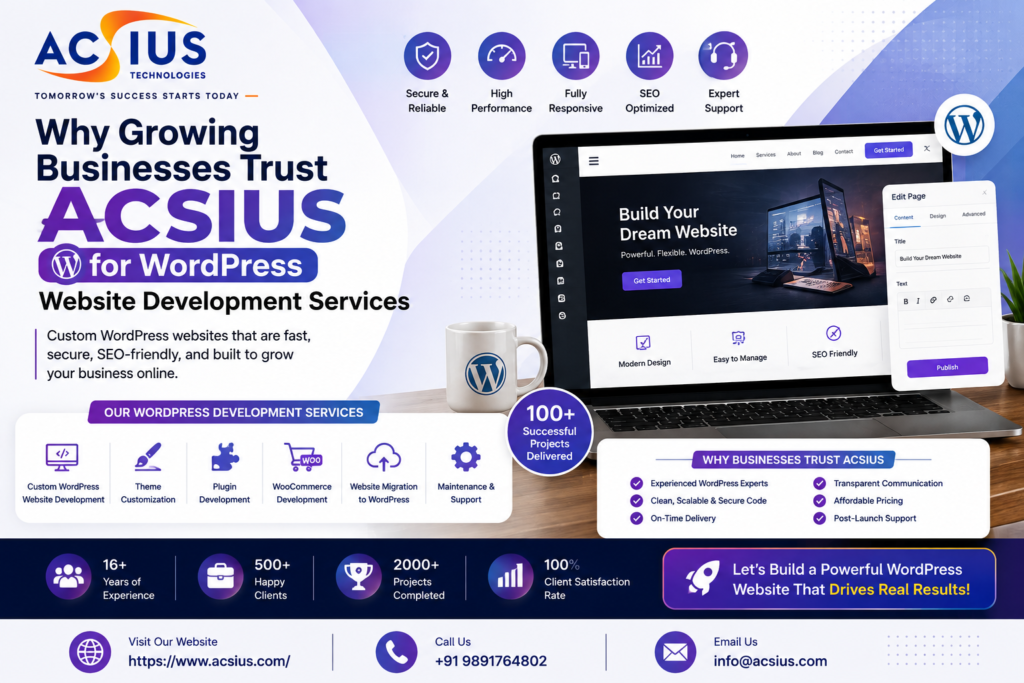
The Core WordPress Website Development Services ACSIUS Provides
Here’s a closer look at how these services typically break down in practice.
Custom WordPress Website Design and Development
Every project starts with understanding what the site needs to do — sell a product, generate leads, publish content, or some combination of the three. From there, development focuses on building a structure and design that fits that specific goal, rather than adapting a generic template and hoping it works.
Theme Customization and Custom Development
Pre-built themes are a reasonable starting point, but they rarely fit a brand perfectly out of the box. Customization work — adjusting layouts, building custom page templates, and modifying functionality — is what makes a site feel intentional rather than templated. For businesses with very specific needs, a fully custom theme built from scratch is often the better long-term investment.
WooCommerce Development for Online Stores
For businesses selling products, WooCommerce turns WordPress into a full ecommerce platform. This includes setting up product catalogs, payment gateways, shipping rules, and — critically — making sure the store can actually handle real order volume without slowing down or breaking during a sale. This is also where many businesses realize they need to hire a dedicated WooCommerce developer rather than relying on general WordPress knowledge, since store-specific issues like cart abandonment, tax rules, and inventory sync require deeper platform expertise.
Website Migration Services
Moving a site to WordPress — from Wix, Squarespace, Shopify, or a custom-built system — carries real risk if it’s handled carelessly. URL structures, indexed pages, and existing search rankings can all be lost in a poorly planned migration. A careful process includes mapping old URLs to new ones, setting up proper redirects, and testing thoroughly before the new site goes live.
Plugin Development and Integration
Not every business need has a ready-made plugin solution. When that gap exists, custom plugin development fills it — connecting a site to internal systems, building unique functionality, or making several existing plugins work together without conflicts.
Website Speed and Performance Optimization
A slow WordPress site is usually the result of bloated themes, too many conflicting plugins, unoptimized images, or poor hosting — not something inherent to the platform itself. Optimization work addresses each of these individually, because speed affects both user experience and search ranking.
Security Hardening and Ongoing Maintenance
WordPress’s popularity makes it a common target for automated attacks. Regular updates, security plugins, backups, and monitoring are essential — not optional extras — for any business site that handles customer data or transactions.
How to Choose the Right WordPress Development Partner
With so many options available, it helps to have a clear filter for evaluating who’s actually worth trusting with a business-critical site.
Look Past the Portfolio Screenshots
Ask for live links to sites they’ve built, not just static images. Check load speed, mobile responsiveness, and how the site actually feels to navigate — not just how it looks in a screenshot.
Ask How They Handle Ongoing Site Health
A site isn’t finished at launch. Ask directly what happens when a plugin update breaks something, or when a security vulnerability is discovered. The answer reveals a lot about how seriously a team takes long-term site health.
Confirm They Ask Questions Before Quoting
A provider who sends a fixed quote without ever asking about the business’s goals, target audience, or existing pain points is often working from a template, not a real understanding of the project.
Clarify Ownership and Access
Confirm upfront that the business retains full ownership of the site, hosting account, and any custom code developed — this should never be a gray area.
WordPress vs. Shopify: Why the Right Platform Depends on the Business
Businesses researching wordpress website development services often end up comparing WordPress against Shopify, and it’s worth addressing that directly rather than pretending one platform is universally better.
WordPress tends to be the stronger choice when:
- Content marketing and blogging are core to the growth strategy
- The business needs highly custom functionality beyond standard ecommerce
- Full ownership and long-term platform flexibility matter
- The site combines ecommerce with significant informational content
Shopify tends to be the stronger choice when:
- The business is a pure product-based store with simpler needs
- Lower long-term maintenance overhead is a priority
- Fast setup matters more than deep customization
A development partner willing to recommend the platform that actually fits — even if it means a different scope of work — is more trustworthy than one who pushes whatever they’re most comfortable building.
The ACSIUS Development Process — What to Expect
Step 1: Discovery and Goal Setting
A conversation focused on understanding the business, its audience, and what the site actually needs to accomplish — not just a features checklist.
Step 2: Planning and Proposal
A clear scope, realistic timeline, and transparent pricing, with no vague line items that turn into surprise costs later in the project.
Step 3: Design and Development
Regular progress updates and opportunities for feedback throughout the build, rather than a single reveal at the very end.
Step 4: Testing Across Devices and Browsers
Every page, form, and interactive element gets tested on multiple devices and browsers before launch, catching issues before real visitors do.
Step 5: Launch and Handover
A smooth go-live process, along with documentation or training so the internal team can manage content confidently without depending on the developer for every small update.
Step 6: Ongoing Support and Maintenance
Continued availability for updates, security patches, and improvements as the business and its needs continue to grow.
Common Mistakes Businesses Make When Hiring WordPress Developers
Choosing based on the lowest price alone. The cheapest option often means the least testing, the least communication, and the most corners cut — costs that show up later in the form of a broken or insecure site.
Skipping the discovery phase entirely. A site built without a clear understanding of the business goal tends to look fine and perform poorly, because it wasn’t designed around actual user behavior.
Overlooking hosting and maintenance planning. A great site on poor hosting still performs badly. This conversation needs to happen before development, not after launch.
Adding too many plugins without a plan. Every plugin adds potential conflicts and slows the site down. A thoughtful developer chooses plugins deliberately rather than installing one for every possible feature.
Not clarifying WooCommerce needs upfront. Ecommerce functionality is different enough from a standard content site that it deserves its own conversation — this is often where the decision to hire a dedicated WooCommerce developer becomes necessary rather than optional.
Understanding the Real Cost of WordPress Website Development Services
Pricing varies significantly depending on scope. A content-focused site with a customized existing theme costs far less than a fully custom WooCommerce store with multiple integrations. Rather than comparing raw numbers across providers, it’s more useful to ask exactly what’s included — testing, revisions, post-launch support, and training — since two quotes with very different price tags can represent very different levels of actual value.
Final Thoughts
WordPress website development services aren’t really about installing a theme and connecting a few plugins — they’re about understanding what a business needs from its site and building toward that goal deliberately. The businesses that get the most value out of the process are rarely the ones chasing the lowest quote; they’re the ones who found a partner willing to ask real questions before writing a single line of code.
At ACSIUS, that’s where every project starts — understanding the business first, then building the site around it. Whether the need is a new WordPress build, a careful platform migration, a WooCommerce store that can handle real order volume, or ongoing support for a site that’s already live, the goal stays consistent: a site that doesn’t just look good, but actually does the job it was built for.
FAQs
Can I migrate my existing site to WordPress without losing my SEO rankings?
Yes, with careful planning — proper URL mapping, 301 redirects, and metadata preservation are essential to protect existing search rankings during the migration.
Do I need a developer if I’m using a pre-built WordPress theme?
Not always for a very basic site, but most businesses eventually need one for customization, plugin conflicts, or functionality the theme's built-in options can't handle.
What’s the difference between hiring a general WordPress developer and a dedicated WooCommerce developer?
A general WordPress developer handles content sites well, but ecommerce introduces specific challenges — payment gateways, tax rules, inventory sync, and cart behavior — that a dedicated WooCommerce developer is better equipped to handle correctly.
How much do WordPress website development services typically cost?
Cost depends heavily on scope, from simple content sites to complex custom builds with ecommerce and integrations. It's more useful to compare what's included in a quote than to compare price alone.
Is WordPress secure enough for a business site?
Yes, when properly maintained. Security depends on regular updates, strong hosting, and proactive monitoring — not something inherent to the platform itself.
Can WordPress handle a large online store?
Yes, WooCommerce can support stores with substantial product catalogs and order volume, provided the site is built on solid hosting and optimized properly for performance at scale.
Will I be able to update my own site after it’s built?
In most cases, yes. A well-built WordPress site should allow a non-technical team to update pages, publish content, and manage products without needing a developer for every change.
What happens if my site breaks after the developer finishes the project?
This depends on the support terms agreed upfront. Some projects include a post-launch support window; others are billed separately, so it's worth clarifying before the project begins.
Should I choose WordPress or Shopify for my business?
It depends on the business model. WordPress tends to suit content-driven businesses and highly custom needs, while Shopify often suits simpler, product-focused stores. A good development partner will recommend based on the actual goal, not platform preference.